
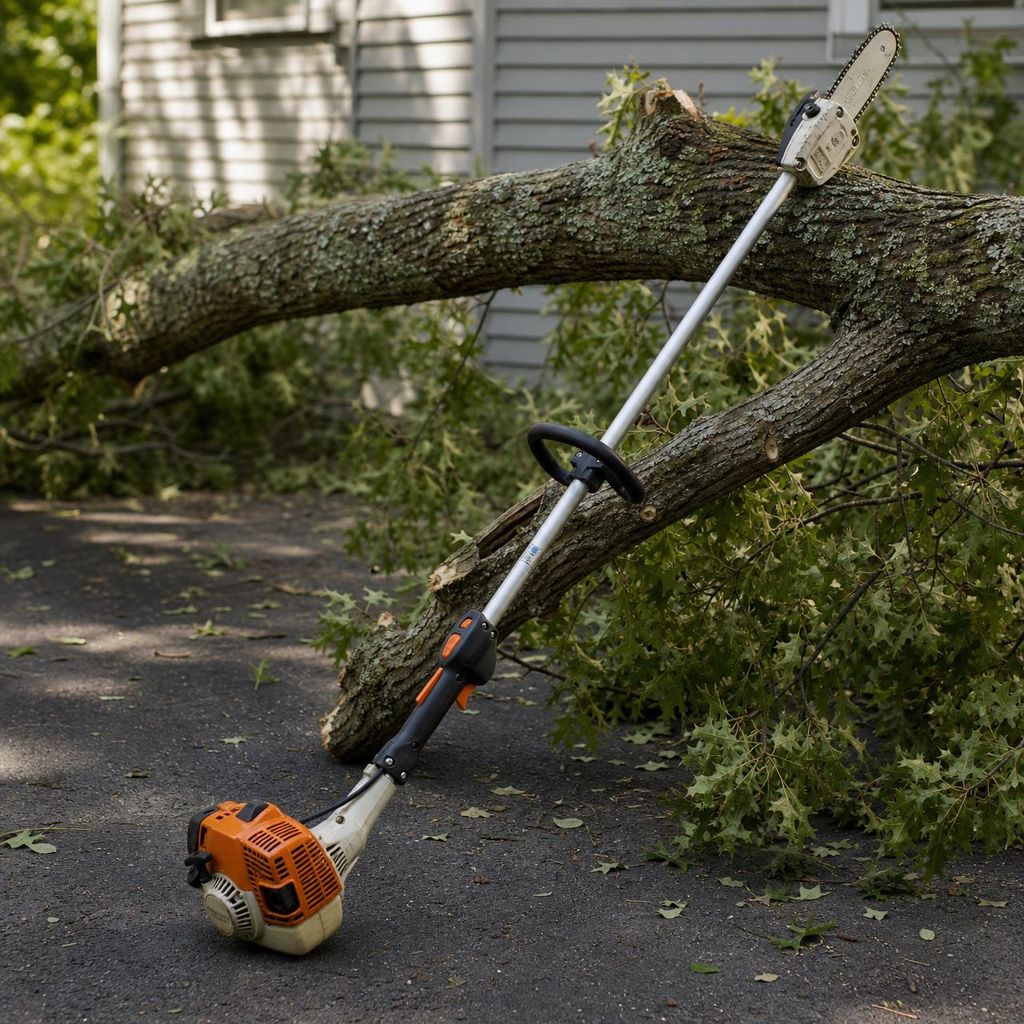
West Michigan earns its storm reputation honestly: summer derechos off the lake plain, fall gales, and ice storms that load every pine limb past its rating. When a tree comes down at midnight, you're suddenly shopping for a service you've never priced, under the worst possible conditions, with rain coming through the ceiling.
This guide is the conversation we'd have on that phone call, written down in advance: what actually counts as an emergency, what the work honestly costs, what to do in the first hour, and how the insurance side works. Read it on a sunny day; it's worth more then.
What counts as a tree emergency
- Tree or limb on the house, garage, or car. The load is unstable by definition — it shifted once and will shift again. People out from under it, then call.
- Tree blocking the driveway or street access. You need out; emergency vehicles need in.
- Hangers over occupied areas. A cracked limb lodged in the crown over the deck or driveway is a countdown, not a curiosity.
- Split trunk still standing. A co-dominant stem that let go halfway is carrying its load on the crack itself.
- Anything touching wires: utility first, always. Consumers Energy (800-477-5050) kills the line; then tree crews work. Nobody reputable touches an energized tree.
What's usually not an emergency: a tree flat in the open yard, hitting nothing. It's done falling — that's a scheduled job at scheduled rates, and answering honestly saves you several hundred dollars. Half our storm-night calls end with "you're safe, we'll come Tuesday, here's what you'll pay."
What emergency work costs in Grand Rapids
Emergency pricing is standard pricing plus urgency — crews called in at night, wet rigging, and work sequenced by hazard instead of efficiency. In 2026 numbers:
Ranges, not quotes — the honest number comes from eyes on the tree, and on storm nights we give it before any saw starts. Two things keep costs down even in an emergency: stabilize-now, finish-later (we make it safe tonight at emergency rates, then complete the removal on schedule at standard ones), and the prevention discount — every $4,000 crane job was once a $1,200 planned removal that a warning sign announced a year earlier.
Why emergency work costs more
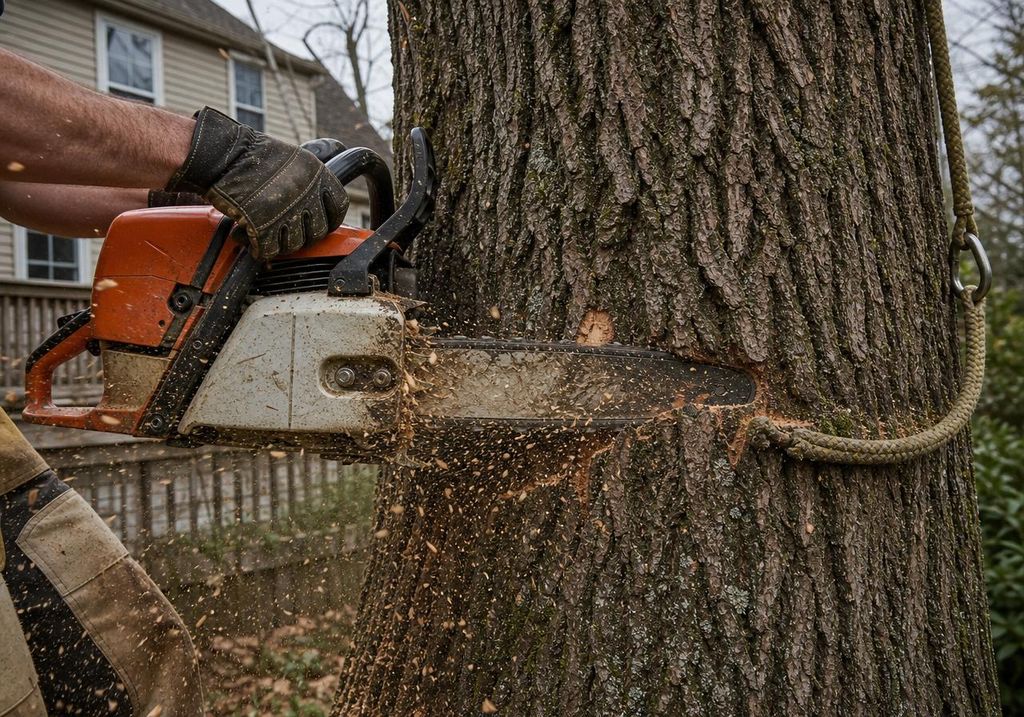
The premium isn't opportunism — it's physics and payroll. A night call means a crew assembled outside working hours, trucks rolling in weather that grounded them all day, and rigging set by floodlight on wood that's wet, cracked, and loaded in directions nature never intended. A tree resting on a structure can't be felled — it has to be dismantled in reverse order of how it landed, each cut calculated so the load lifts off the roof instead of punching through it, often with a crane whose mobilization alone runs four figures. And storm-night routing is triage, not efficiency: crews crisscross the county by hazard severity instead of running an optimized route. Same saws, same people — three times the constraints.
It's also why the stabilize-now-finish-later split works: the expensive part is the urgent part. Once the tree is off the house and the tarp is tight, the remaining trunk on the lawn is just a scheduled removal at scheduled rates.
What to do in the first hour
- People first. Everyone out from under the damage, out of rooms below sagging ceilings, away from the root plate.
- Wires: assume live. If the service drop is pulled or any line is involved, call the utility before anything else and keep everyone clear — an energized tree electrifies the wet ground around it.
- Photograph before anything moves. Wide shots and close-ups, for the claim. Two minutes now saves weeks later.
- Call the emergency line: (616) 612-1244. Describe what hit what — you’ll get a straight answer about urgency, timing, and honest cost before anyone rolls.
- Mitigate what you safely can. Tarp interior water damage, keep receipts — insurers expect mitigation and typically reimburse it. Never climb on the roof or near the tree to do it.
One storm-season warning: the guys who knock. After every major blow, out-of-state pickups with chainsaws work the damaged neighborhoods door to door — cash up front, no insurance certificates, no local address, gone by the weekend. Some do adequate work; the ones who drop a second limb through your porch roof do not, and their liability policy is a shrug. Whoever you hire at 2 a.m., ask for two things before anyone climbs: proof of liability and workers' comp insurance, and a local address you could drive to next month. An uninsured crew's injury on your property becomes your homeowners claim — the exact policy you're already leaning on for the tree.
Our 24/7 response, step by step
The call is answered by someone who does the work, not a service. We triage by hazard: dwellings and people first, access second, debris third. On site, the sequence is assess → stabilize → remove → document: rigging or crane work takes the load off the structure without a second impact, the tree comes off in controlled sections, and everything is photographed as we go because the claim needs it. Cleanup finishes when the driveway is passable and the roof is tarp-tight — and the final invoice is itemized the way adjusters want, separating structure work, removal, and hauling. That's the whole reason to keep a 24/7 line: the storm doesn't schedule around anyone.
Insurance and emergency work
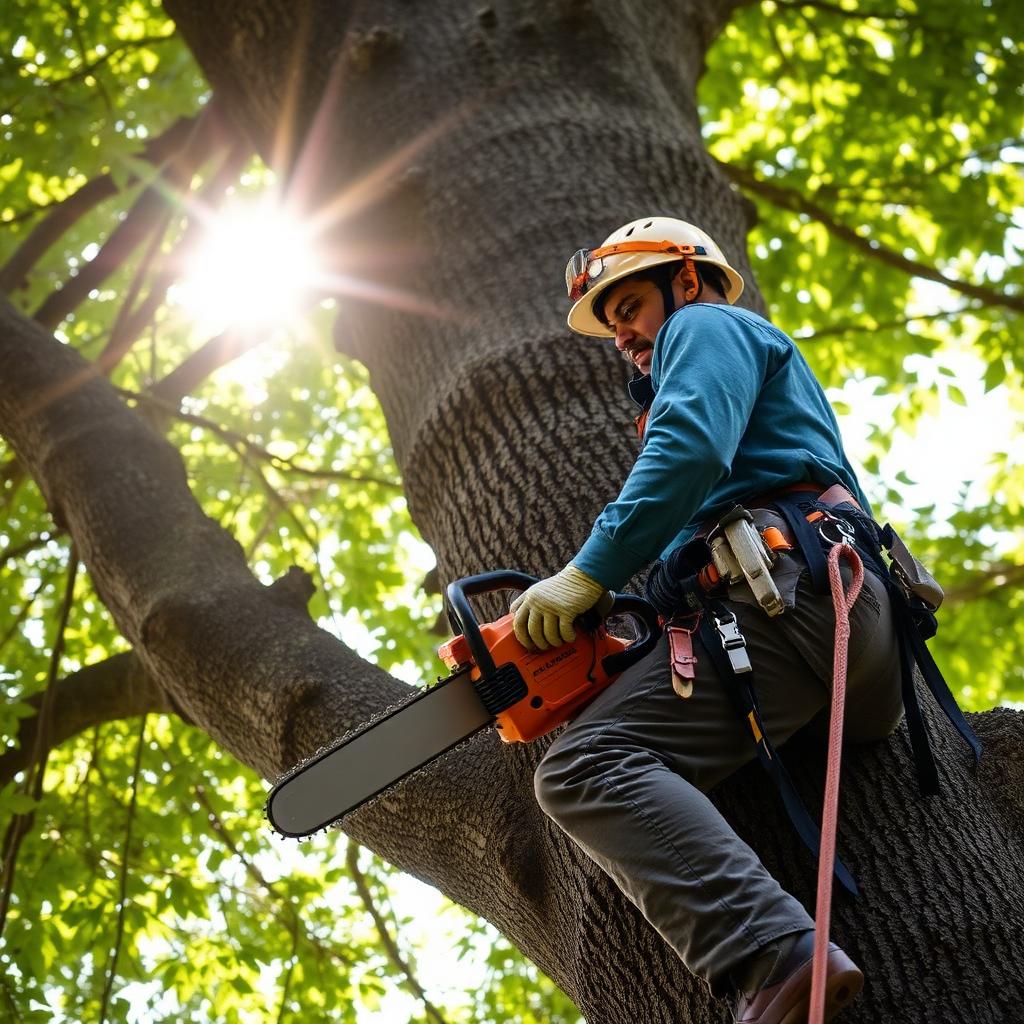
Short version: if the tree hit a covered structure, your homeowners policy generally pays for removal and repairs (minus deductible, within per-tree sub-limits that commonly run $500–$1,000), and reasonable emergency stabilization is typically reimbursable. If it fell in the open yard, it's usually on you. Documentation decides the close speed — photos before cleanup, a written assessment, an itemized invoice. The complete playbook, including the neighbor's-tree rules and when a claim isn't worth filing, is in does homeowners insurance cover tree removal in Michigan.
Frequently asked questions
A straightforward fallen tree — down in the yard or across a driveway — typically runs $350–$750 to clear. Structural situations (tree on the house, crane work, night rigging) run $1,500–$5,000. Expect a 50–100% premium over scheduled rates for after-hours response, and 2–3× for structural work.
Usually, when the tree hit a covered structure — including reasonable emergency stabilization like tarping. Document everything before cleanup and keep itemized receipts. Full rules are in our Michigan insurance guide.
The utility — Consumers Energy at 800-477-5050 — and nobody touches the tree until the line is confirmed dead. No tree crew, ours included, works energized lines; the utility clears its equipment, then we clear the tree.
Yes — the emergency line is answered around the clock, every day of the year. Storm nights get triaged: people-and-dwelling situations first, blocked driveways next, yard debris when the sun’s up.
Jason leads Diversified Tree Service LLC, an owner-operated, fully-insured crew serving Grand Rapids and West Michigan — 10+ years in business with 25+ years of combined crew experience in tree removal, trimming, and storm response. BBB accredited · 24/7 emergency.