
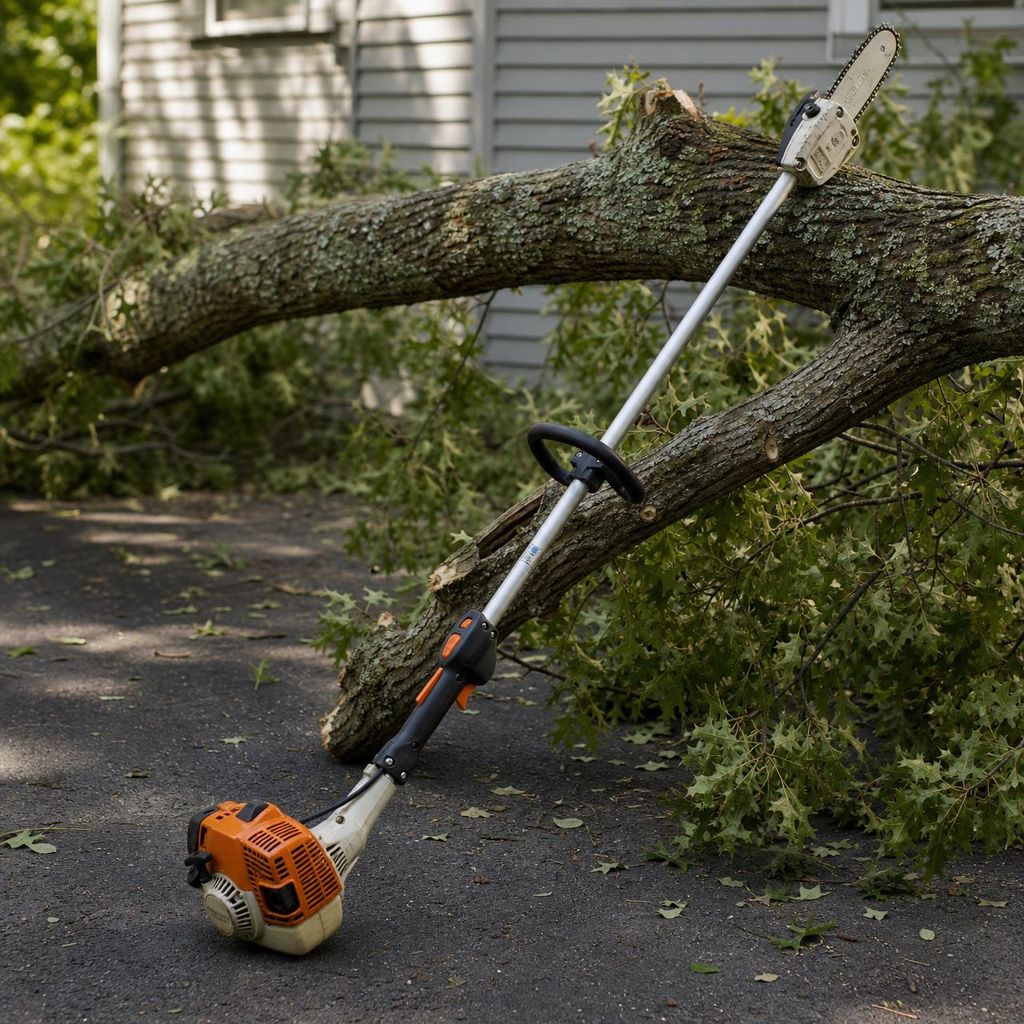
Every West Michigan storm season, the same phone call: "A tree just came through the garage — does my insurance cover this?" The answer is usually yes when the tree hit something, and no when it didn't. That one distinction decides most claims, and knowing the rest of the rules before you're standing in the driveway at midnight makes the whole process faster and cheaper.
Here's how tree claims actually work in Michigan — what's covered, what the limits look like, and the documentation that makes adjusters say yes. (This is general information from a tree crew that works alongside a lot of claims, not insurance advice — your policy is the contract, so confirm specifics with your carrier.)
The general rule: damage triggers coverage
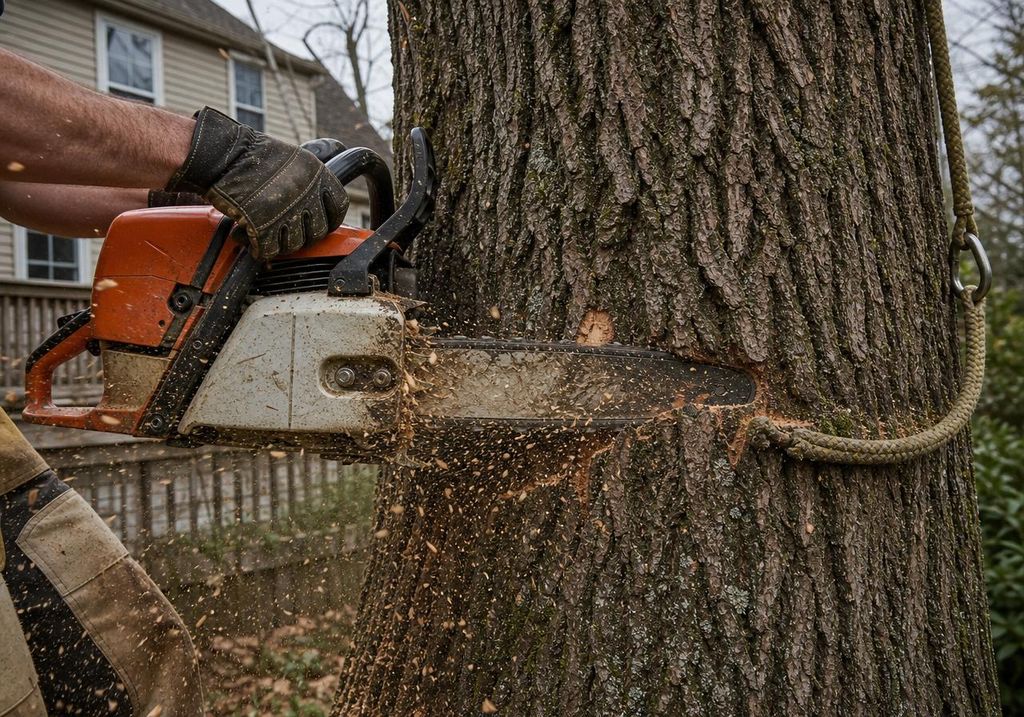
Homeowners insurance is damage insurance, not tree insurance. If a tree — yours or a neighbor's — strikes a covered structure (the house, an attached garage, a detached garage, shed, fence, or deck), the policy generally pays to repair the structure and to remove the tree from it. If the same tree falls harmlessly in the open yard, most policies pay nothing: the removal is on you. And preventive removal of a standing hazard tree is never covered — which is the strongest financial argument for handling a known problem tree on your own schedule at standard rates.
Typical coverage and limits
- Structure repair falls under your dwelling or other-structures coverage, minus your deductible.
- Tree/debris removal is usually sub-limited. Many Michigan policies cap it at $500–$1,000 per tree (sometimes per occurrence) once the structure damage is covered.
- Driveway blockage: many policies pay for removal when a fallen tree blocks a driveway or a ramp for the disabled, even without structure damage — check yours.
- Landscaping sub-limits (often ~5% of dwelling coverage) may apply to replacing lost trees and shrubs after a covered peril.
- Your deductible applies — a $1,000 deductible against a $900 removal means no payout, so small single-tree jobs often aren’t worth a claim.
Common scenarios, called honestly
The "neglected tree" row deserves emphasis: adjusters look at the stump. A tree that was obviously dead for years — bare all summer, bark sloughing, fungus at the base — gives the carrier grounds to argue you failed to maintain it. Documented maintenance (or a removal quote you acted on) protects the claim.
What Michigan storm claims look like
Wind, lightning, and the weight of ice and snow are covered perils on standard Michigan policies — and they're our specialty seasons. After a derecho or ice storm, carriers are processing thousands of claims at once; clean documentation moves yours to the front of the line. Flood-related tree failures are the exception — groundwater and flood damage follow different rules (flood policies), so riverside properties should read that fine print.
Recent seasons have made the point locally: the August 2024 derecho put trees through roofs from Wyoming to Lowell in a single afternoon, and the ice storms that followed that winter loaded pines past their limits for a week straight. In both events, homeowners with same-day photos and itemized invoices closed claims in weeks; the ones who let a landscaper haul everything away first spent months arguing about what the damage had looked like. The tree is the evidence — document it before it leaves the property.
The first 48 hours, step by step
When a tree comes down on a structure, the order of operations matters — both for safety and for the claim:
- First minutes — safety triage. Everyone out from under the damage. If any wire is involved or the service drop is pulled from the house, stay clear and call Consumers Energy (800-477-5050) before anyone touches the tree; a downed line energizes the whole root plate.
- First hour — photograph everything. Wide shots, close-ups, the base of the tree, the sky-facing damage. Then call for emergency tree response; a tree resting on a roof shifts with every gust, and the second impact is usually worse than the first.
- Same day — open the claim. Call your carrier’s 24-hour claim line with your policy number. Ask two questions on that first call: what is my per-tree removal sub-limit, and do you need to send an adjuster before permanent repairs.
- First days — mitigate and keep receipts. Tarping the roof opening, boarding windows, removing the immediate load — these are mitigation, insurers expect them, and reasonable costs are typically reimbursable. Save every receipt and don’t start permanent repairs until the adjuster has seen (or waived seeing) the damage.
- First week — assemble the packet. Photos, the crew’s written assessment, the itemized invoice, mitigation receipts. One organized email beats five phone calls.
How to document a claim that gets paid
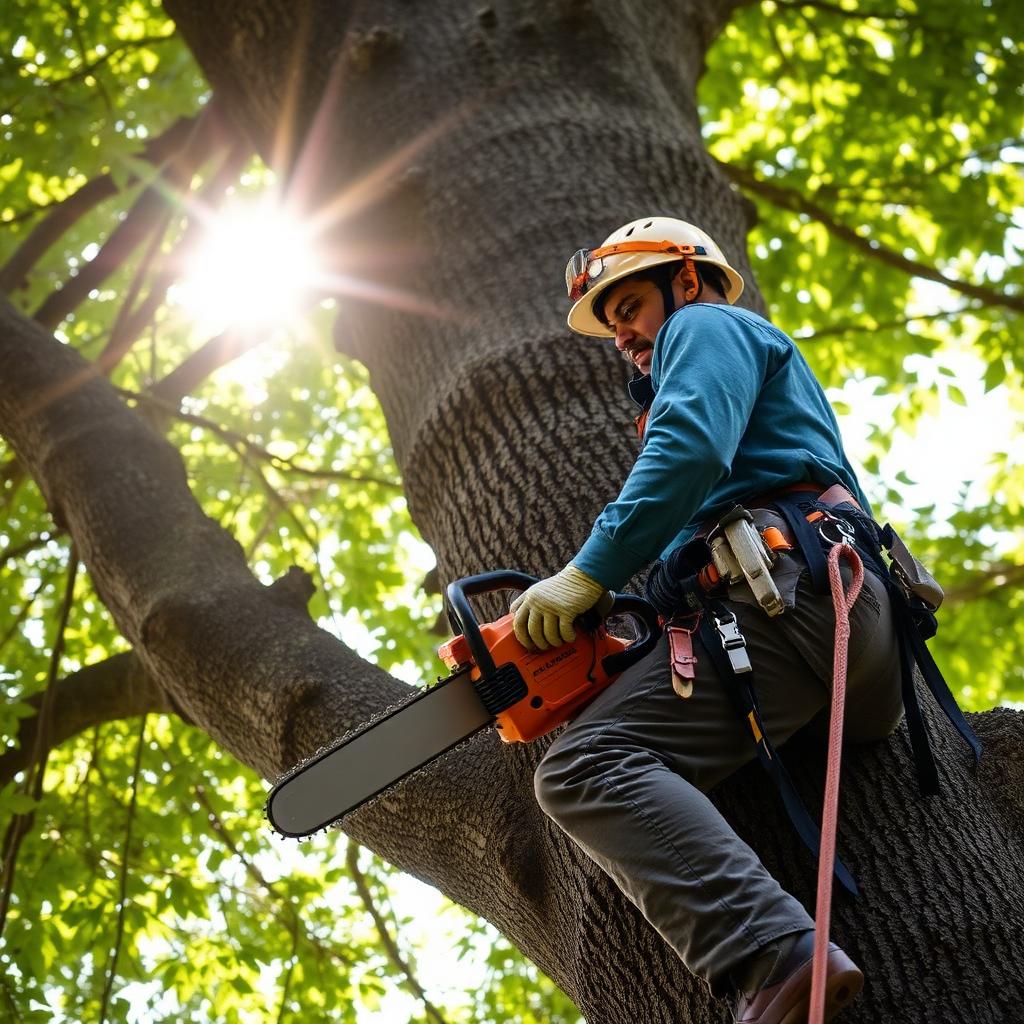
- Photograph everything before anything moves — wide shots showing tree + structure, close-ups of impact points, and the tree’s base.
- Get a written assessment from the tree crew: what failed, why, and what’s required to remove it safely.
- Demand an itemized invoice that separates removal-from-structure, debris hauling, and any stabilization work — sub-limits apply per line item, and lumped invoices get haircut.
- Keep receipts for emergency mitigation (tarping, board-up) — reasonable mitigation costs are typically reimbursable, and carriers expect you to prevent further damage.
When a claim isn’t worth filing
Not every covered loss is worth claiming. Run the math first: if removal-plus-repair lands near your deductible, the payout is small — and a filed claim sits on your CLUE report for up to seven years, where it can nudge premiums at renewal. A $700 fence repair against a $1,000 deductible is a no-brainer: pay it yourself. A tree through the roof trusses is the opposite: that's exactly what the policy is for, and hesitating only risks further damage. The gray zone in between is worth a conversation with your agent before the claim number is issued — asking hypothetically doesn't create a record; opening a claim does. And remember the sub-limits: if your policy caps tree removal at $500 per tree, a $1,400 removal invoice returns $500 minus nothing extra — the structure repair is where the real coverage lives.
How we handle insurance jobs
We work storm claims across Grand Rapids every year: 24/7 emergency response to stabilize and remove the immediate hazard, photos taken before and during the work, itemized invoices formatted the way adjusters want them, and direct answers when the adjuster calls us. What that whole process costs — including the emergency premium — is broken down in our emergency tree service cost guide, and standard planned pricing is in the tree removal cost guide. One more paperwork note: if the tree involves the street right-of-way, the city has a say too — see our permit guide.
Frequently asked questions
Usually not. Most Michigan policies only pay for removal when the tree damages a covered structure or blocks a driveway/ramp. A tree that drops harmlessly in the yard is typically the homeowner’s cost.
Yours — you file with your own carrier regardless of where the tree grew. If the neighbor knew the tree was dead or hazardous and ignored it, your insurer may pursue their policy (subrogation), which can get your deductible back.
No. Preventive removal is never covered — and that’s exactly why it’s worth doing. A planned removal costs a fraction of an emergency crane job plus your deductible.
Immediately. Photograph everything before any cleanup, call your carrier’s claim line the same day, and get the tree stabilized or tarped to prevent further damage — insurers expect you to mitigate, and reasonable emergency costs are typically reimbursable.
General information only, not insurance advice. Coverage varies by policy and carrier — confirm specifics with your insurance company.
Jason leads Diversified Tree Service LLC, an owner-operated, fully-insured crew serving Grand Rapids and West Michigan — 10+ years in business with 25+ years of combined crew experience in tree removal, trimming, and storm response. BBB accredited · 24/7 emergency.