
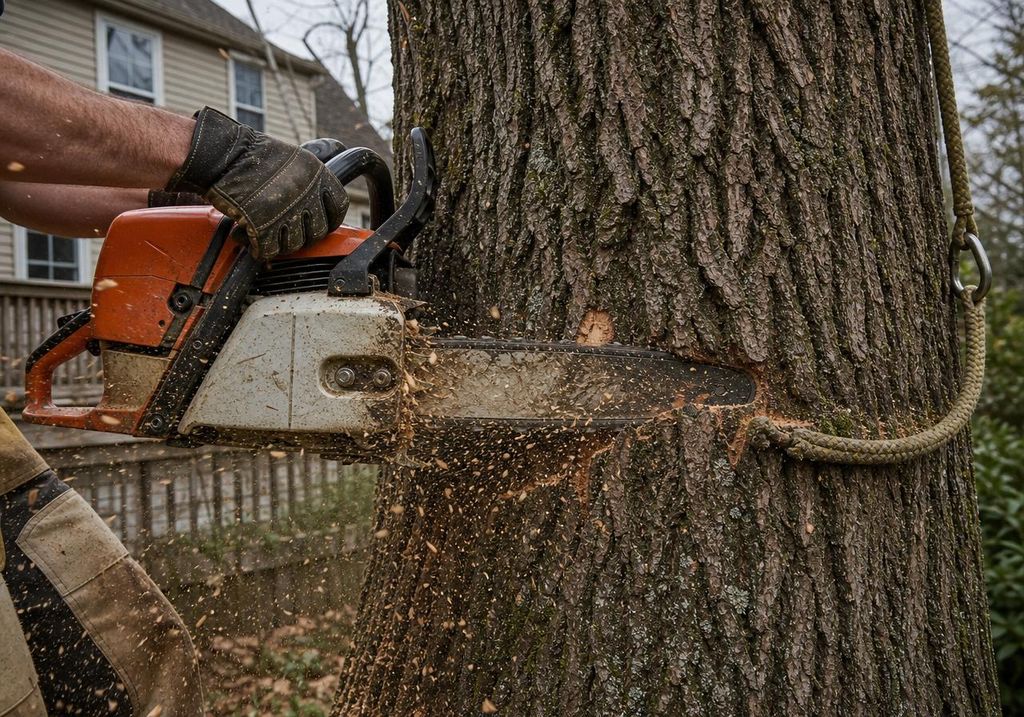
"How much is this going to cost me?" It's the first question on every estimate we run, and the honest answer is: it depends on the tree. In 2026, most Grand Rapids homeowners pay somewhere between $400 and $1,900 to have a tree removed, with the citywide average landing around $1,100. A small ornamental in an open front yard might be a few hundred dollars; a storm-weakened silver maple leaning over your garage with power lines through the crown is a different job entirely.
This guide breaks down what actually drives those numbers — size, condition, access, and timing — so when quotes come in, you can read them like a pro instead of guessing. Everything below reflects what we see on real jobs across Grand Rapids, Kentwood, Wyoming, and the surrounding Kent County suburbs.
Average tree removal cost in Grand Rapids (2026)
Across the removals we quote each year, the overall average sits near $1,100 per tree. Most routine residential jobs land between $500 and $5,000 once you account for size and access, and the middle of the market — the typical backyard maple, ash, or spruce — runs $400 to $1,900. Those aren't guaranteed quotes; they're the honest bands we see across the metro, and your tree will land somewhere inside them based on the factors below.
Cost by tree size
Height is the single biggest predictor of price, because it dictates crew time, equipment, and how much of the tree has to be roped down in pieces rather than felled. Here's how 2026 pricing shakes out by size class in West Michigan:
What drives the price up or down
Two trees of identical height can be quoted a thousand dollars apart, and it's almost always one of these factors. A three-person crew with equipment runs roughly $200–$260 per hour in our market, so anything that adds hours adds cost:
- Access. A tree the bucket truck can park next to is cheap. A backyard tree behind a fence, pool, or septic field means climbing and hand-carrying — often the single biggest price swing.
- Proximity to structures and power lines. Anything overhanging a roof, garage, or service drop must be rigged and lowered piece by piece. Utility-line clearance may involve the power company first.
- Species and wood density. Oak and hickory are heavier and slower to process than pine or spruce; multi-stemmed silver maples take more rigging points.
- Condition. Dead and decaying trees (EAB-killed ash especially) can't safely hold a climber, which forces bucket or crane work at a higher rate.
- Stump grinding. Usually quoted separately — typically $103–$134 per stump. See our stump grinding cost guide for the full breakdown.
- Hauling and cleanup. Full haul-away vs. leaving bucked wood on site (free firewood!) can move a quote a few hundred dollars.
Emergency vs. scheduled removal
Storm and after-hours work typically adds 30–50% to standard pricing, and structural situations — a tree resting on your roof that has to be craned off without shifting weight — can run 2–3× a planned removal. That premium buys a crew at 2 a.m., but it's also why the smartest money in tree care is removing a known hazard on your schedule, not the storm's. We covered the full emergency picture in what emergency tree service costs in Grand Rapids.
Does insurance help?
Sometimes. The general rule: if the tree hit a covered structure — house, garage, fence — your homeowners policy usually pays for removal (minus deductible, up to policy limits). If it simply fell in the yard, that's typically on you. Preventive removal of a healthy tree is never covered, and a neglected, obviously-dead tree can even complicate a later claim. The full rules, limits, and documentation tips are in does homeowners insurance cover tree removal in Michigan.
How to get an accurate quote
Phone estimates for tree removal are guesses — anyone quoting a firm price sight-unseen is either padding heavily or planning to "discover" charges later. A real quote takes a walk around the tree. When you compare bids, make sure you're comparing like for like:
- Is stump grinding included or separate?
- Is wood hauled away, chipped, or left bucked on site?
- Is the company fully insured — liability and workers' comp? (Ask for certificates; an uninsured crew's accident becomes your homeowner claim.)
- Does the price include lawn protection and full cleanup, or "broom clean" only?
- Might the tree need a permit or right-of-way approval? Street-side trees in Grand Rapids belong to the city's Forestry division.
And before booking any removal, it's worth confirming the tree actually needs to come down — our guide to the 7 signs a tree needs to be removed covers what we look for on an inspection. When you're ready, professional tree removal in Grand Rapids starts with a free on-site estimate — request yours here.
Frequently asked questions
Most removals average around $1,100, with a typical range of $400–$1,900. Small trees run $500–$1,000; medium 30–60 ft trees $1,000–$2,500; large 60–80 ft trees $2,500–$4,000; and crane or complex jobs $5,000–$10,000+.
Different companies include different things — stump grinding, hauling, cleanup — and carry different insurance. A low bid that excludes all three isn't actually low. Compare scope line by line, and always confirm liability and workers' comp coverage.
Usually only when the tree strikes a covered structure. A tree that falls in the open yard is typically the homeowner's cost. Policies differ — confirm specifics with your carrier, and see our Michigan insurance guide.
Often, yes. Dormant-season scheduling is more flexible, frozen ground protects lawns from equipment, and demand is lower than in storm season. If the tree isn't an immediate hazard, booking for winter is a smart way to save.
Jason leads Diversified Tree Service LLC, an owner-operated, fully-insured crew serving Grand Rapids and West Michigan — 10+ years in business with 25+ years of combined crew experience in tree removal, trimming, and storm response. BBB accredited · 24/7 emergency.